
Scelleuse sous vide pour viande: Vitesse de la pompe, Niveau de vide, et performance d’étanchéité
Partager:
-

-

-

-


Copié
Partager:
-
-
-
-
Copié
Lors de l’examen des facteurs importants pour l’évaluation d’un scelleur sous vide conçu pour la viande, il faut aller au-delà de la simple fonction d’extraction de l’air d’un sac. Other factors such as how fast the pump can remove air from the bag (pump speed), what level of vacuum is achieved (Niveau de vide), and whether or not the bag can be sealed under vacuum (sealing stability) must also be considered.
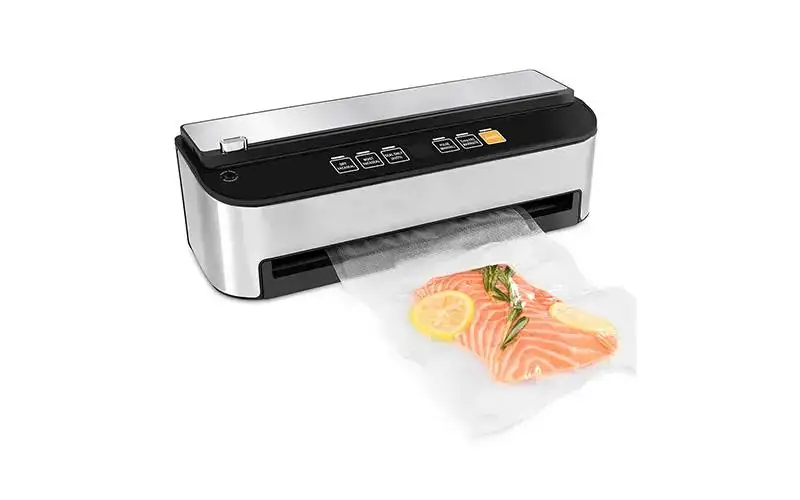
À YUMYTH, we integrate these three factors together in one system. En d’autres termes, how fast the pump can evacuate air from a bag (Capacité de la pompe) determines how low the vacuum can be set (Niveau de vide), and at the end of a cycle, whether or not that vacuum can be maintained (sealing stability).
For fresh beef, Porc, poulet, and marinated meat, moisture adds another challenge. A technically well-designed Vacuum Sealer for Meat therefore needs both vacuum power and precise process control.
How a Vacuum Sealer for Meat Builds a Reliable Seal
A typical vacuum-and-seal cycle includes four stages:
- Air extraction – The pump removes air through the open end of the textured vacuum bag.
- Vacuum development – Pressure inside the package gradually decreases.
- Heat sealing – The heating bar bonds the bag layers together.
- Seal stabilization – The heated seam cools before the package is released.
Each stage affects the next. Fast air extraction is useful, but poor moisture management can contaminate the sealing zone. De même, a strong vacuum is ineffective if the heat seal later develops a leak.
Pump Speed vs. Niveau de vide
The following terms are used to describe different features of a Vacuum Sealer for Meat, and are frequently misinterpreted.
| Term | Example Values | Description of Term | Importance |
| Vitesse de la pompe | 5 L/min | Airflow capacity | Improves sealing speed |
| Niveau de vide | -80 kPa | Degree of vacuum | More negative pressure indicates better vacuum |
| Moist/Dry Mode | - | Adapts process to food condition | Used to prevent food from drying out |
| Contrôle d’impulsions | - | Allows manual control of vacuum process | Allows evacuation of liquids |
| Barre d’étanchéité | 6 mm | Contact width | Sealing bar temperature also affects seal strength |
Vitesse de la pompe (in the example above) is a measure of airflow, and thus vacuum speed. It does not determine ultimate vacuum level. Par exemple, a vacuum level of -100 kPa is not possible with a pump speed of 5 L/min.
Pump speed and vacuum level are to be interpreted differently.
Is -80 kPa Better Than -60 kpa?
Pas forcément. A vacuum level of -60 kPa is suitable to remove the air in a bag of meat. Further decrease in pressure is not necessary. Cependant, if the meat is still under pressure, vacuum level should be adjusted to remove as much air as possible to allow the meat to fit in the bag.
When selecting a vacuum level, Considérons:
• Meat thickness and structure
• Surface moisture
• Bag size and empty headspace
• Amount of liquid or marinade
• Desired package compression
• Condition of the sealing area
The objective is not simply to reach the largest negative-pressure number. The objective is to create a stable package without introducing sealing problems.
Moisture Is a Major Variable in Meat Vacuum Sealing
Fresh meat naturally releases moisture. During evacuation, the pressure difference inside the bag can cause that liquid to migrate toward the vacuum channel.
This matters because liquid at the bag opening can interfere with the heat-sealing process.
What happens when meat juice reaches the seal?
Possible problems include:
• Uneven heat transfer between bag layers
• Reduced polymer-to-polymer contact
• Wrinkles or channels across the sealing line
• Incomplete seal formation
• Gradual loss of vacuum during storage
Pour cette raison, a Vacuum Sealer for Meat benefits from a dedicated Moist mode and controllable vacuum function rather than relying only on maximum suction.
Why Seal Integrity Matters as Much as Vacuum Strength
A vacuum reading tells you what happens before sealing. Seal integrity determines what happens after sealing.
After most of the air is removed, some seals still leave a tiny microscopic channel that allows air to re-enter the package.
Various factors influence the success of a seal. Celles-ci incluent:
• Using the correct sealing temperature
• Degassing for the appropriate length of time
• Applying even pressure to the length of the sealing bar
• Using bag film of the appropriate gauge
• Having a clean, smooth edge on the opening of the bag
• Managing the level of moisture on the bag film
• Ensuring adequate cooling before the bag film is separated
A useful way to evaluate a Vacuum Sealer for Meat is:
Air Removal + Vacuum Control + Moisture Management + Heat-Seal Integrity = Stable Vacuum Package
Integration of these features produces a stable or USDA accepted vacuum package.
Comparison of vacuum levels in a system does not add much value.
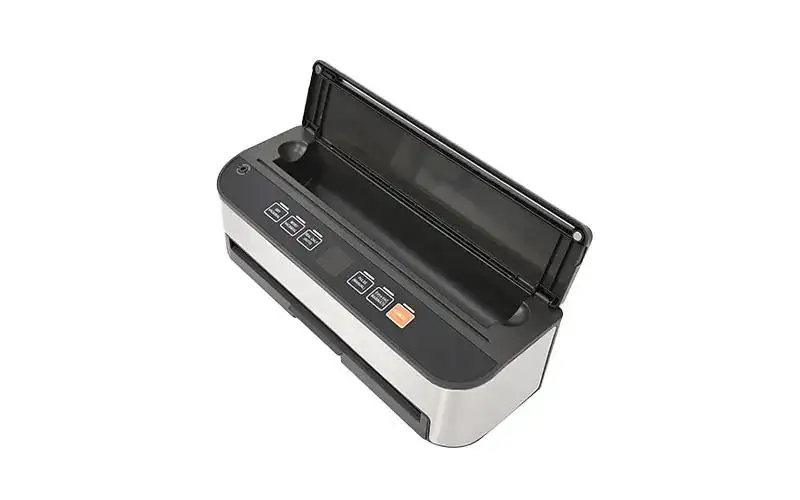
YUMYTH VS6685H Vacuum Sealer
Le YUMYTH VS6685H achieves the features described above by using a vacuum pump with an air flow rate of 5 or 8 L/min. The pressure of the vacuum can be set to 60 or 80 kPa. The sealing element has a height of 3 mm. The vacuum sealer can seal a bag up to 30 cm wide.
| VS6685H Specification | Configuration |
| Pompe à vide | 5 L/min or 8 L/min optional |
| Pression sous vide | -60 kPa or -80 kPa optional |
| Puissance nominale | 120W |
| Maximum Work Width | 30 cm |
| Barre d’étanchéité | 3 mm, Single |
| Food Modes | Dry VAC & Seal / Moist VAC & Phoque |
| Manual Vacuum | Pulse |
| Other Functions | Scellement uniquement, Extra-VAC/Marinate, Cancel |
| Matériel | ABS + Stainless Steel |
| Tension | AC100–120V / AC220–240V |
| Fréquence | 50–60 Hz |
For a Vacuum Sealer for Meat, several of these specifications directly affect usability.
Moist VAC & Phoque
The Moist setting is intended for foods where surface moisture can influence sealing conditions. It provides a more suitable operating approach than treating moist meat exactly like dry ingredients.
Pulse Vacuum Control
Pulse mode allows the user to control evacuation manually. This is useful when sealing juicy meat, delicate portions, or marinated foods because the vacuum can be stopped before excessive liquid reaches the sealing area.
3 mm Sealing Bar
The 3 mm single sealing bar provides a defined heat-contact area across the package opening. Largeur du joint, heat distribution, État du sac, and sealing time work together to create a stable seam.
Plateau goutte-à-goutte amovible
The VS6685H includes a removable drip tray for collecting liquid residue that enters the vacuum area, simplifying cleaning after handling moist foods.
Common Vacuum Sealing Mistakes to Avoid
Even a well-designed Vacuum Sealer for Meat requires correct bag preparation.
• Do not overfill the bag.
Leave enough empty material above the meat for air extraction and sealing.
• Keep the bag mouth flat.
Wrinkles can create small air channels across the seal.
• Control surface liquid.
Too much liquid near the opening can affect the seal.
• Complete vacuum is not always the end goal.
Use Pulse when you need to finely control the evacuation of liquid or when you need a specific texture in the meat.
• Inspect the finished seal.
A continuous, flat sealing line is just as important as the vacuum level achieved during the cycle.
Choosing a Vacuum Sealer for Meat as a Complete System
When evaluating a Vacuum Sealer for Meat, pump speed should answer how efficiently air is removed, vacuum level should answer how much pressure reduction can be achieved, and the sealing system should answer how reliably that vacuum can be retained.
Contrôle de l’humidité, manual vacuum adjustment, Largeur du sac, sealing-bar design, and cleaning convenience complete the picture.
À YUMYTH, the VS6685H combines optional 5/8 L/min pump capacity, -60/-80 kPa vacuum pressure, Dry and Moist modes, Contrôle des impulsions, a 3 mm sealing bar, automatic lid operation, built-in roll storage and cutter, and a removable drip tray in one coordinated design.
If you are evaluating a Vacuum Sealer for Meat and want to compare vacuum configuration, Contrôle de l’étanchéité, or product customization options, you can review the complete VS6685H technical specifications and discuss the appropriate configuration directly with YUMYTH. Explore the YUMYTH VS6685H Automatic Vacuum Sealer
FAQ
Q1. What vacuum pressure does the YUMYTH Vacuum Sealer for Meat provide?
The YUMYTH VS6685H is available with -60 kPa or -80 kPa vacuum pressure options. The appropriate configuration depends on the desired vacuum intensity, food texture, and sealing requirements.
Q2. What pump speed options are available on the YUMYTH VS6685H?
YUMYTH offers 5 L/min and 8 L/min vacuum pump options. A higher pump flow can remove air faster, although pump speed and final vacuum pressure are separate performance factors.
Q3. Is the YUMYTH Vacuum Sealer for Meat suitable for fresh meat?
Oui. The VS6685H includes Dry VAC & Seal and Moist VAC & Modes d’étanchéité, allowing users to adapt the sealing process to dry foods or meat containing surface moisture.
Q4. What is the purpose of Pulse mode on the YUMYTH vacuum sealer?
Pulse mode gives users more manual control over air extraction. It is useful when sealing soft meat, juicy portions, or marinated food where excessive suction could draw liquid toward the sealing area.
Q5. How wide is the sealing bar on the YUMYTH VS6685H?
The machine uses a 3 mm single sealing bar, providing a defined heat-sealing area for creating a continuous closure across compatible vacuum bags.
Articles connexes

Machine à snish domestique: À savoir avant d’en acheter un en 2026
2026-09-24
PAR YUMYTH
Une machine à slush domestique fabrique des boissons glacées à la maison. Ça fonctionne différemment d’un blender. Un blender écrase de la glace dans votre boisson, ce qui ajoute de l’eau et atténue la saveur. ...
Comment fonctionne une machine à glace à nuggets? Un aperçu du processus de fabrication de glace
2026-09-24
PAR YUMYTH
La glace Nugget semble assez simple. Petit, Des morceaux de glace mous tombent dans la poubelle, prêt à aller dans un verre. Mais créer cette texture est très différent de faire un....
Machine à glaçons pépite pour café: Comment la texture de la glace affecte le café
2026-09-24
PAR YUMYTH
Lors du choix d’une machine à glaçons Nugget pour un café, Il y a de nombreux facteurs à prendre en compte en dehors du taux de production de glace. À YUMYTH, Nous considérons les implications en aval....
Pourquoi la glace nugget pour soda offre une sensation différente des glaçons traditionnels
2026-09-24
PAR YUMYTH
À YUMYTH, nous pensons qu’il y a plus à Nugget Ice pour les sodas que l’effet sur la température. La structure de la glace modifie également la perception de la carbonatation, À quelle vitesse....