
Machine à glace à pépites vs. Explication du fabricant traditionnel de glaçons
Partager:
-

-

-

-


Copié
Partager:
-
-
-
-
Copié
Si vous vous êtes déjà retrouvé à croquer machinalement la glace restante au fond d’un gobelet de soda de fast-food, Vous connaissez déjà la magie distincte de la glace pépite. But when it comes to upgrading your home kitchen or wet bar, choosing the right appliance is not as simple as flipping a coin. The great debate between investing in a high-end nugget ice maker versus a dependable traditional ice cube maker usually boils down to one fundamental question: what is the actual difference?
Frozen water may appear to be just that—frozen water—to the inexperienced eye. But any expert bartender or beverage enthusiast will immediately correct you. The texture, melting rate, manufacturing technique, and overall effect on your favorite drinks are completely different. We'll analyze the engineering behind each of these well-known devices in this in-depth guide, compare how useful they are on a daily basis, and assist you in determining which appliance is more deserving of that coveted space on your countertop.
The Anatomy of a Traditional Ice Cube Maker
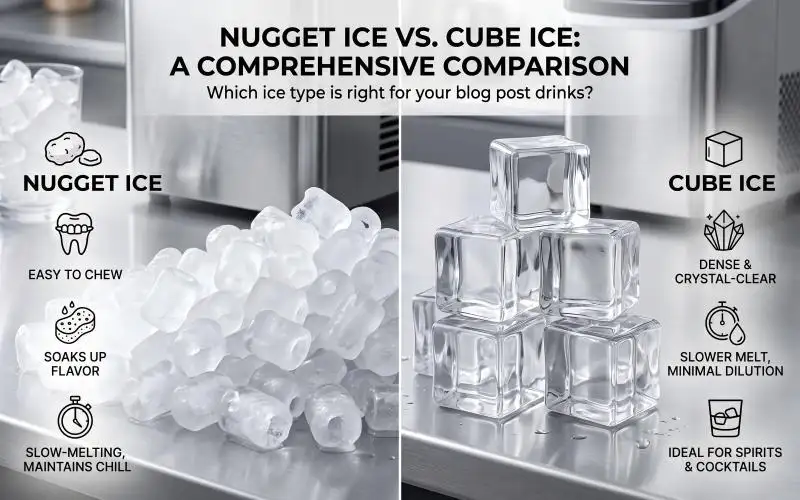
Let us start with the classic. When most people think of an ice maker, this is the machine that comes to mind. The workhorses of the refrigeration industry, traditional ice cube producers are made to create long-lasting, solid, dense blocks of ice.
The Freezing Process: Molds and Cascades
A comparatively simple thermodynamic process powers a typical ice cube maker. The device pumps water into a designated mold or over a chilled metal grid. Layer by layer, the water gradually freezes as it passes over the freezing surface. Impurities are automatically pushed away by the cascading process because pure water freezes at a greater temperature than water with impurities or dissolved minerals. This is precisely why ice made using a top-notch commercial or under-counter ice cube maker is extremely dense and crystal clear.
Best Applications for Solid Cubes
Because these cubes are solid and lack internal air pockets, they melt at an incredibly slow rate. This makes the traditional ice cube the undisputed king of high-end cocktails, neat spirits, and large outdoor coolers. If you are pouring an expensive glass of scotch, you want an ice cube that chills the liquor without instantly diluting it into a watery mess. For long summer barbecues, solid cubes will keep your sodas and beers cold for hours on end.
The Engineering Behind the Nugget Ice Maker
On the opposite end of the spectrum, we have the nugget ice maker. Originally confined to hospitals and drive-in fast-food chains, this specialized machine has recently taken the residential market by storm. But how exactly does it create that signature chewable texture?
How "Chewable" Ice is Born: Cylindrical, Not Cubes
Here is the biggest secret: a nugget ice maker does not use a mold. The device has a refrigerated stainless steel cylinder rather than freezing water into a solid block. Water enters the cylinder and freezes to the walls, forming a thin layer of ice. One by one, little ice cubes are formed as the ice is finally forced out of the cylindrical ice outlet at the top.
These loose ice flakes are then pushed up through a small extrusion tube, which tightly compresses them together into tiny, cylindrical pellets. Think of it like packing a snowball with your hands. Because the nugget is essentially a compressed ball of ice flakes and air, it is inherently soft, porous, and heavily aerated.
The Cult Following of Pellet Ice
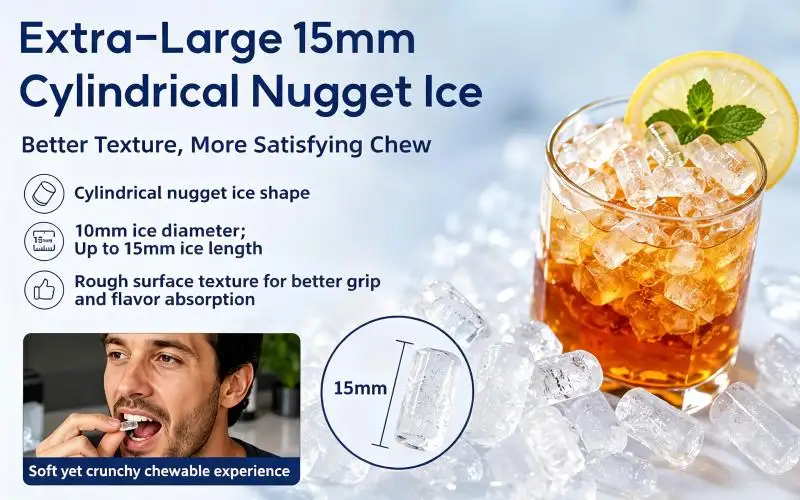
The porous nature of nugget ice means it acts exactly like a sponge. When you drop nugget ice into a glass of iced coffee, sweet tea, or flavored soda, the liquid instantly penetrates the ice. When you eventually chew the ice, you are not just crunching on frozen water; you are enjoying a flavor-packed burst of your beverage. This unique characteristic has created a massive cult following, making the countertop nugget maker one of the most highly sought-after kitchen appliances of the decade.
Head-to-Head Comparison: The 4 Major Differences
Now that we understand how each machine works, let us break down the practical differences you will experience when operating them in your home.
1. Texture and Density (The Crunch Factor)
As established, traditional cubes are dense, hard, and smooth. Chewing on a solid ice cube is generally a bad idea unless you are eager to pay your dentist a visit. Nugget ice, cependant, is fragile and easily yields to the bite. If you or your family members are habitual ice-chewers, a nugget machine is virtually mandatory.
2. Melting Speed and Beverage Dilution
This is where the traditional ice cube maker wins effortlessly. Because nugget ice is full of air pockets and has a massive surface-area-to-volume ratio, it melts extremely fast. This is perfectly fine for highly concentrated drinks like soda fountain syrups or robust cold brews, but it is an absolute disaster for delicate liquors or fine wines. If dilution is your enemy, stick to solid cubes.
3. Machine Maintenance and Durability
Nugget ice makers are mechanically complex. They rely on moving parts—specifically the rotating auger—grinding against freezing surfaces constantly. De plus,, because they pack flaked ice tightly, mineral scale from hard water can easily jam the extrusion process. Par conséquent, a nugget ice maker requires strict, frequent descaling and cleaning routines. A traditional ice cube maker, while still requiring maintenance, is generally far more forgiving and boasts a longer mechanical lifespan due to its simpler freezing mechanisms.
4. Upfront Cost and Energy Efficiency
Let us talk about the financial investment. Engineering a machine that continuously scrapes and compresses ice is expensive. Par conséquent, a reliable countertop nugget maker will typically carry a much higher price tag than a countertop ice cube maker of a similar size.
Making the Choice: Quelle machine vous convient?
Au final de la journée, neither machine is universally superior; it entirely depends on your lifestyle, your beverage preferences, and your willingness to perform routine maintenance.
Buy a Traditional Ice Cube Maker If...
You consider yourself a home bartender who frequently mixes craft cocktails. It is also the ideal choice if you host outdoor parties and need ice that will survive in a cooler for hours under the hot sun. Enfin, if you want an appliance that is relatively low-maintenance and highly durable, the classic cube machine will never let you down.
Buy a Nugget Ice Maker If...
You absolutely love chewing ice and want to recreate that nostalgic fast-food or cafe experience right in your kitchen. If your daily beverage rotation consists heavily of iced lattes, smoothies, fruit punches, and sodas, this machine will elevate your drinks to an entirely new level. Just be prepared to commit to a regular cleaning schedule to keep that auger spinning smoothly.
Purchasing a dedicated ice maker is a luxury that, once you get used to it, becomes a necessity. You can choose the equipment that best suits your culinary lifestyle by being aware of the practical and mechanical distinctions between a nugget ice maker and a conventional ice cube maker.
Articles connexes
Comment tester chaque machine à glace avant l’emballage
2026-09-15
PAR YUMYTH
Un aperçu étape par étape de la gestion des réfrigérants, Vérification du refroidissement, Détection des fuites, Action corrective et tests de sécurité électrique pour une machine à glaçons, La fiabilité des performances est déterminée bien avant que le carton ne soit scellé. ...
Guide pour les marques à la recherche d’un fournisseur OEM fiable de scelleuses sous vide
2026-09-14
PAR YUMYTH
Lorsque vous achetez des appareils de cuisine pour votre marque de détail, Trouver un fournisseur fiable de scelleuses sous vide ne se limite que rarement à obtenir le prix unitaire le plus bas. Il s’agit de protéger....

Pourquoi la forme de la glace est importante: Comprendre la glace de pépite cylindrique de 10 mm × 15 mm
2026-09-14
PAR YUMYTH
Plus que la production de glace — la glace elle-même façonne l’expérience du consommateur lors de l’achat d’une machine à glaçons à pépites, Les acheteurs se concentrent souvent d’abord sur la capacité de production, Taille du réservoir d’eau, panier à glace....
Guide d’approvisionnement en machine à glace: Comment trouver la bonne usine
2026-09-10
PAR YUMYTH
Trouver une machine à glace semble simple sur le papier. Trouvez un fournisseur, D’accord sur un prix, Passer une commande. Mais quiconque a réellement fait cela sait que le processus est rarement....