
Commercial Vacuum Sealer Machine with Chamber and External Vacuum
Partager:
-

-

-

-


Copié
Partager:
-
-
-
-
Copié
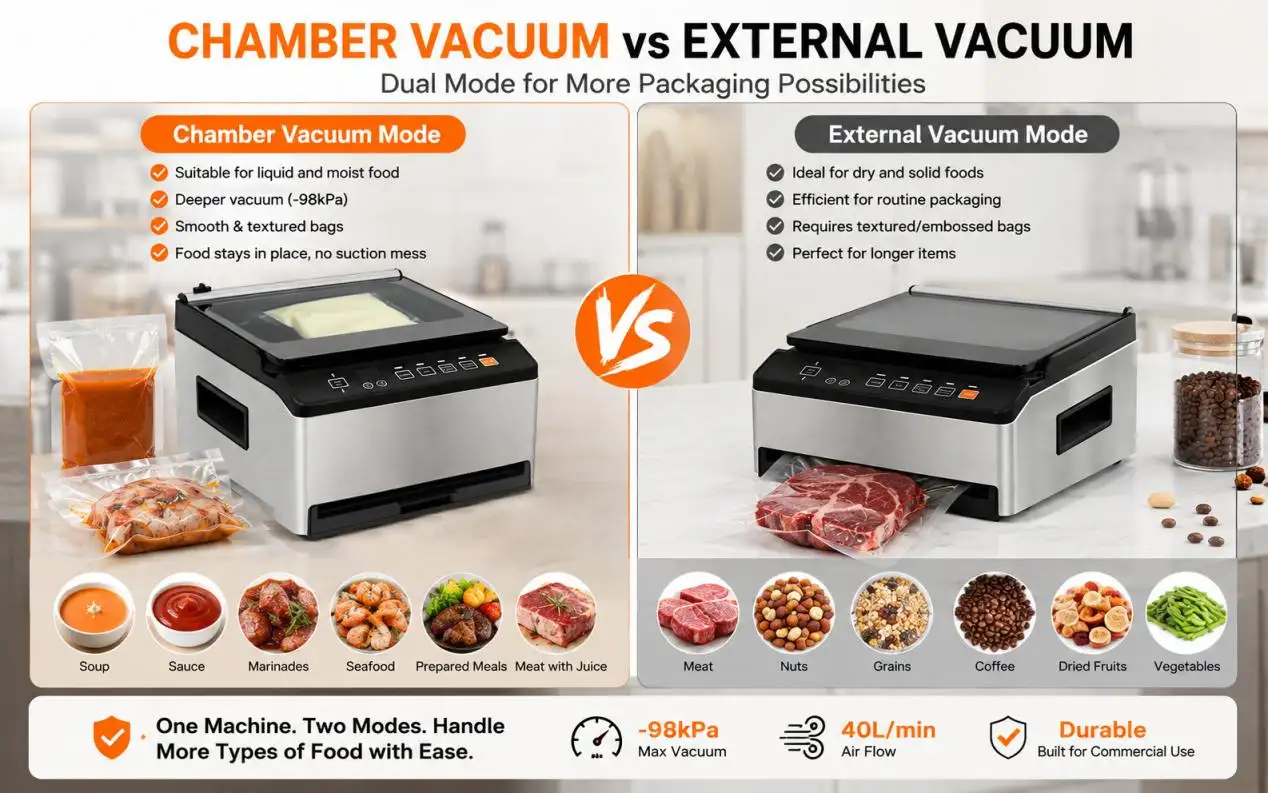
A Commercial Vacuum Sealer Machine must do more than reach a high vacuum number. For food processors, Restaurants, Distributeurs, and private-label equipment buyers, actual sealing performance depends on how vacuum pressure, Débit de pompe, Structure du sac, Largeur d’étanchéité, Humidité alimentaire, and cycle frequency work together.
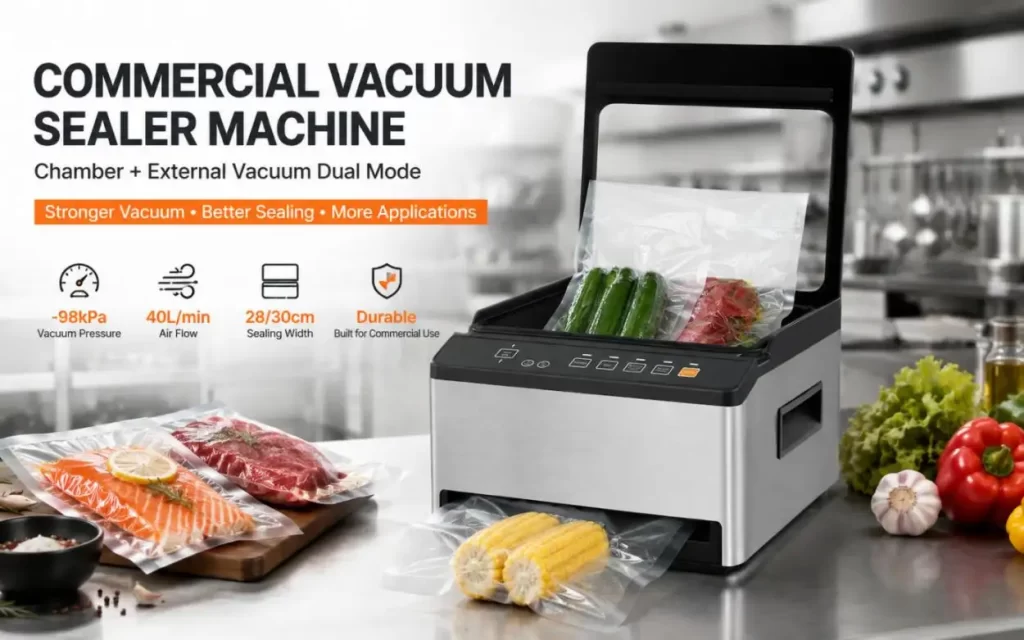
This becomes particularly important when one operation handles both liquid-rich foods and conventional dry products. External vacuum sealing is efficient for routine textured-bag packaging, but liquids can be pulled toward the vacuum channel. Chamber sealing solves this problem differently by reducing pressure around the entire package.
YUMYTH designed the CVS101 Commercial Vacuum Sealer Machine around these two operating conditions, integrating chamber vacuum and external vacuum into one platform rather than forcing one vacuum method to handle every packaging task.
Why Chamber and External Vacuum Are Needed for Different Foods
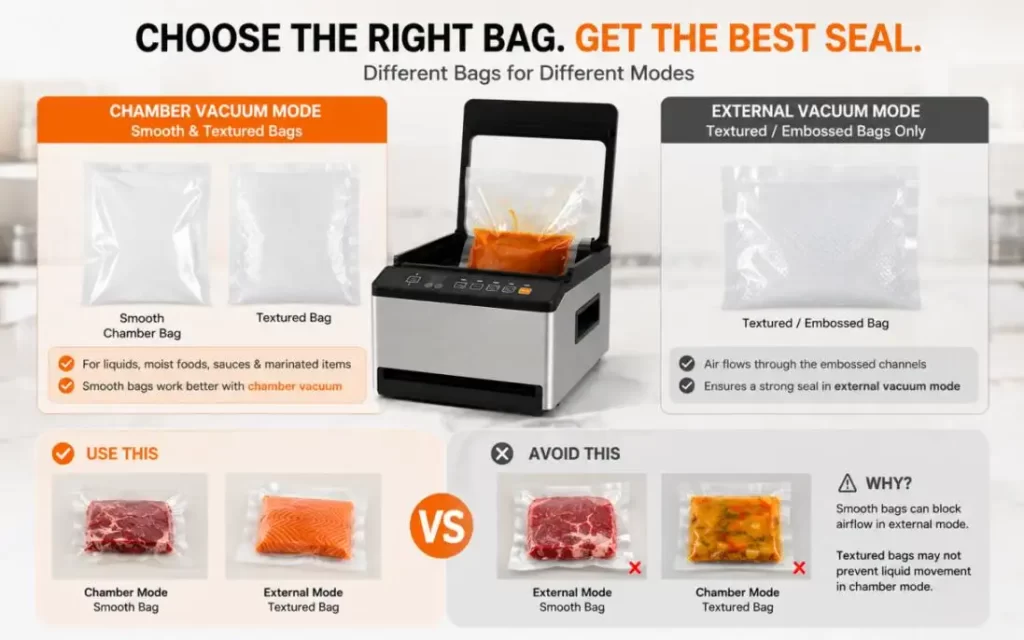
An external vacuum system removes air through the bag opening. For air to travel efficiently, the bag normally requires embossed channels that prevent the two film surfaces from collapsing together before evacuation is complete.
This works well for:
•Dry meat and seafood
•Écrous, Céréales, et café
•Portion-packed ingredients
•Textured vacuum bags
•Products that cannot easily fit inside a chamber
The problem changes when free liquid is present. Sauce, marinade, or meat juice may move toward the vacuum inlet before the desired vacuum level is reached.
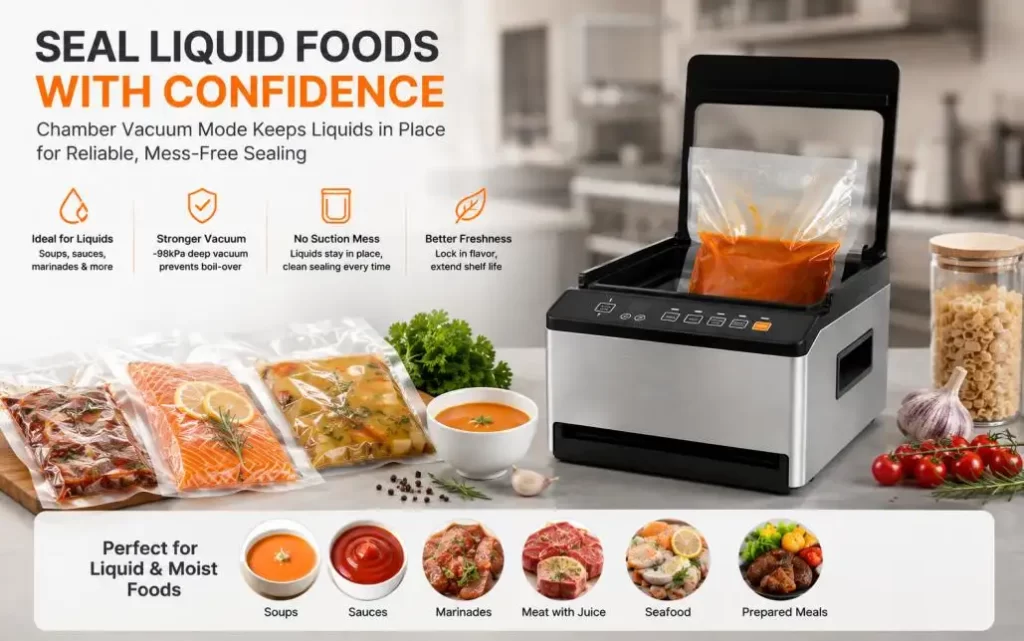
A chamber Commercial Vacuum Sealer Machine reduces pressure inside the entire chamber. Pressure around the bag and inside the package falls together, allowing liquid products to be handled more predictably before sealing.
Typical chamber applications include:
•Soups and sauces
•Marinated meat
•Moist seafood
•Prepared meals
•Liquid-containing food portions
•Smooth commercial vacuum bags
This is the main technical reason YUMYTH combines both systems in the CVS101.
-98kPa and 40L/min Describe Different Vacuum Characteristics
One of the most common purchasing mistakes is comparing vacuum sealers only by pressure.
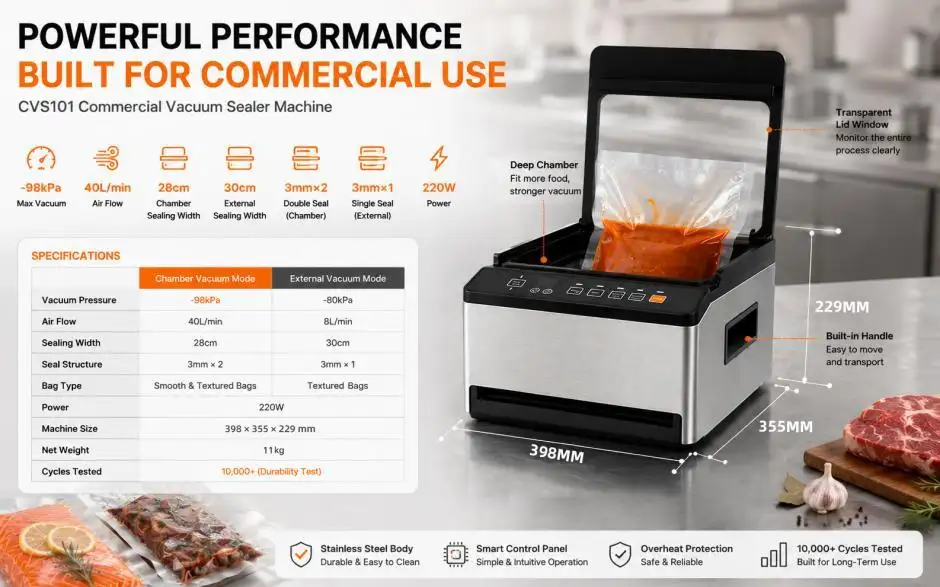
The CVS101 chamber system is specified at -98kPa with 40L/min airflow, while external vacuum reaches -80kPa with 8L/min airflow.
These figures measure different properties.
| Paramètre | What It Measures | CVS101 Chamber | CVS101 External |
| Pression sous vide | Profondeur de vide atteignable | -98 kPa | -80kPa |
| Débit de la pompe | Air displacement rate | 40L/min | 8L/min |
| Largeur de travail | Largeur maximale d’étanchéité | 28 cm | 30 cm |
| Seal Structure | Configuration des joints | 3mm × 2 | 3mm × 1 |
| Type de sac | Compatible bag structure | Smooth + textured | Texturé |
Vacuum pressure determines how far pressure can be reduced; airflow determines how quickly air can be moved.
A 40L/min system therefore should not automatically be described as five times faster than an 8L/min system. Actual evacuation time also depends on:
•Chamber free volume
•Product displacement
•Package volume
•Target vacuum pressure
•Vacuum-time setting
•Seal-time setting
For a Commercial Vacuum Sealer Machine, pressure and flow should always be evaluated together.
Chamber Vacuum vs. External Vacuum: Selecting the Correct Mode
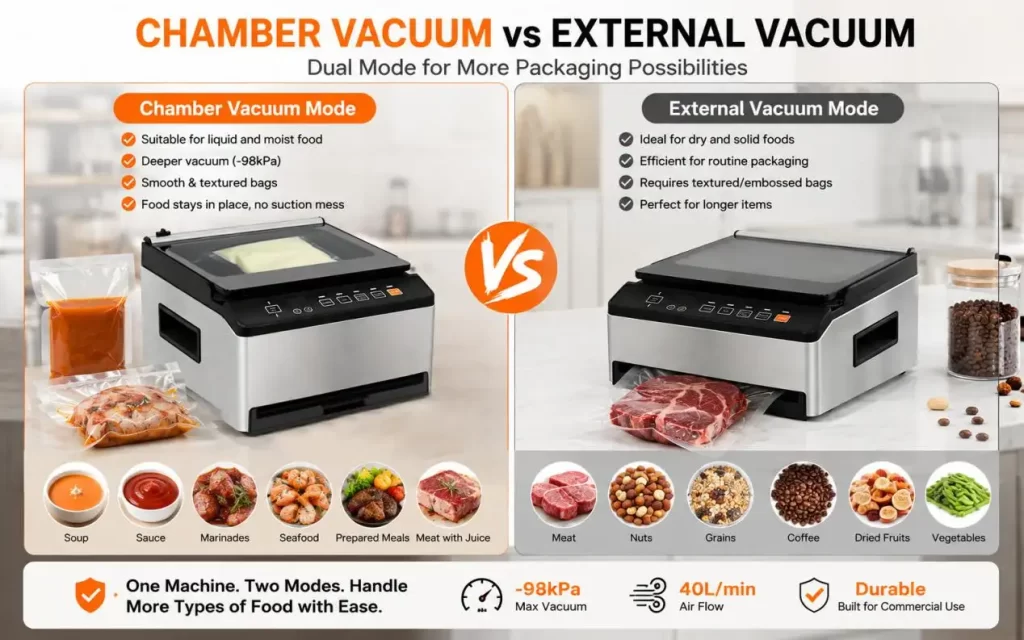
The dual-mode system is useful because each method solves a different packaging problem.
| Packaging Condition | Chamber Vacuum | External Vacuum |
| Liquid food | Preferred | Limité |
| Nourriture humide | Preferred | Dépendant de l’application |
| Nourriture sèche | Suitable | Suitable |
| Sac à chambre lisse | Suitable | Not suitable |
| Sac embossé | Suitable | Suitable |
| Deeper vacuum requirement | Better suited | Modéré |
| Large/long package | Chamber-size limited | More flexible |
| Routine dry-food sealing | Suitable | Efficace |
A dual-mode Commercial Vacuum Sealer Machine therefore makes most sense where packaging conditions change frequently rather than where one identical package is sealed continuously.
Why Bag Construction Matters
Smooth chamber bags do not need embossed airflow channels because air is removed by changing the pressure of the entire chamber.
External vacuum is different. Once smooth film surfaces collapse against each other, the evacuation path can become restricted. Embossed bags maintain microscopic channels through which air can reach the vacuum port.
Bag compatibility is therefore not a minor accessory issue—it affects both operating cost and packaging reliability.
Double Sealing Is More Than a Product Feature
The chamber side of the CVS101 uses a 3mm × 2 double sealing bar, while external sealing uses one 3mm seal.
The purpose of two chamber seal lines is additional sealing redundancy, especially where moisture near the bag opening could affect seal integrity.
Cependant, seal quality cannot be judged by seal width alone. It depends on the relationship between:
Bag Material → Seal Time → Heat Input → Cooling → Seal Integrity
Important variables include:
•Film thickness
•Heat-seal layer composition
•Moisture at the sealing interface
•Seal-bar temperature
•Heating duration
•Cooling interval
•Repeated-cycle frequency
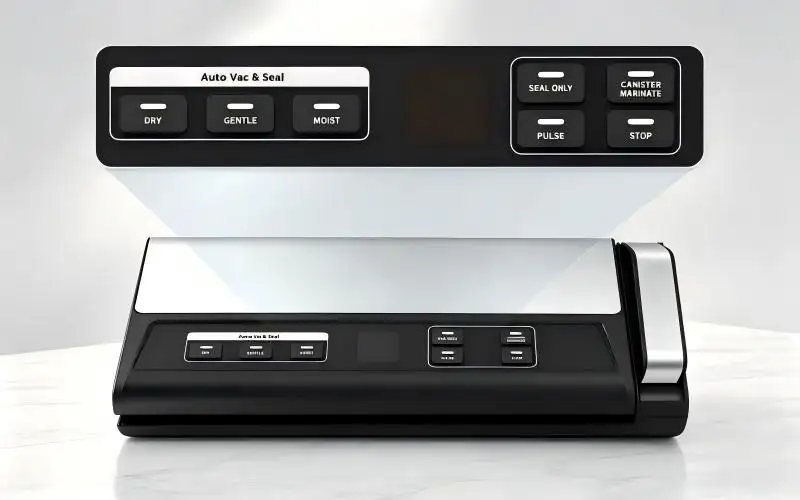
Pour cette raison, YUMYTH provides adjustable Vac Time and Seal Time, together with Pulse control for more sensitive packaging conditions.
Package Dimensions Must Be Checked Before Machine Selection
Working width does not mean every 28cm bag will automatically fit inside the chamber.
The CVS101 supports:
•Chamber sealing width: up to 28cm
•External sealing width: up to 30cm
•Machine dimensions: 398 × 355 × 229mm
•Net weight: 10,5kg
For chamber packaging, buyers also need to consider:
•Product height
•Product thickness
•Bag orientation
•Usable chamber space
•Required headspace above the seal
If the product exceeds practical chamber dimensions but remains suitable for external vacuum packaging, the external mode provides another processing route without requiring a second machine.
Repeated Sealing Depends on Thermal Management
Vacuum speed alone does not determine throughput.
Every operating cycle includes:
Evacuation → Sealing → Heat Dissipation → Next Cycle
During repeated use, the seal bar accumulates heat. Excessive temperature can change seal quality or trigger protective systems.
The CVS101 incorporates:
•NTC overheating protection
•Thermal fuse protection
•Adjustable sealing time
•Countdown display for cycle monitoring
YUMYTH rates the unit for 3,000 cycles and reports testing to 10,000 Cycles. These figures should be treated as manufacturer durability-test data rather than a guaranteed service life. Actual operating life varies with workload, heat settings, Entretien, bag material, and environmental conditions.
Moist-Food Packaging Requires Better Residue Control
A Commercial Vacuum Sealer Machine used for moist food requires more frequent cleaning than a dry-food-only system.
A drip tray is one of many features CVS101 has to make daily cleaning easy. The materials of CVS101, like SUS430 stainless steel, ABS, tempered glass, Surfaces lisses, and a detachable power cord, make cleaning more efficient.
The following should be examined on a periodic basis:
•Chamber and lid
•Gasket area
•Double sealing bars
•External vacuum channel
• Plateau goutte-à-goutte
•Accessory hose
Food and liquid particles should not build up around the sealing and vacuum paths to maintain consistent pressure and sealing.
Electrical and Compliance Should Be Verified Prior to Importing
YUMYTH adjusts CVS101 to the following:
•AC100 – 120V or AC220 – 240V
•50 – 60 Hz
•220 W rated power
Importers should verify voltage, plug configuration, electric, and food-contact documentation and complies with the market requirements before ordering.
CE,UKCA,UL, ETL, RoHS, PORTÉE, or other standards should be confirmed against the applicable machine and market documents rather than assumed from general product information.
Is a Dual-Mode Commercial Vacuum Sealer Machine the Right Choice?
A dual-mode Commercial Vacuum Sealer Machine is particularly useful when the same operation handles liquid, humide, sec, smooth-bag, textured-bag, and different-size packaging tasks.
The CVS101 combines a -98kPa chamber system, -80kPa external vacuum, 40L/min chamber airflow, double chamber sealing, Contrôle des impulsions, five-cycle marinating, accessory vacuuming, and removable liquid management in one coordinated platform.
For buyers evaluating whether chamber-and-external vacuum technology fits their packaging volume, bag specifications, and food categories, YUMYTH can provide CVS101 technical data and configuration information for a more accurate application assessment before purchase.
FAQ
Q1. How are chamber and external modes different on the YUMYTH CVS101?
Chamber mode decreases air pressure on the vacuum bag to -98kPa (used for moisture, liquides, and smooth bags), and external mode reaches -80kPa for use on textured vacuum bags and common dry food packaging.
Q2. Does the YUMYTH CVS101 Commercial Vacuum Sealer machine seal liquids?
Oui. The CVS101 machine can vacuum seal liquids because of its chamber mode, and is even capable of moist food and liquid foods that contain sauces and marinades, and smooth meat and seafood.
Q3. What is the capacity of the CVS101 vacuum pump?
For the chamber mode, the vacuum system can process 40L/min of airflow, while the external mode processes 8L/min. Pump flow describes the rate of air displacement, while the -98kPa and -80kPa shows the lowest vacuum pressure achievable.
Q4. What types of vacuum bags can be used with this Commercial Vacuum Sealer Machine?
The chamber mode works with smooth and textured vacuum bags. The external vacuum mode requires Sacs texturés to allow air to flow properly during vacuuming.
Q5. What is the maximum bag width supported by the CVS101?
For the chamber mode, the maximum bag width is 28 cm, and for the external mode, the maximum bag width is 30 cm. For chamber packaging, it is important for buyers to know the overall height and thickness of the product, and if it will fit in the chamber.
Articles connexes
Comment tester chaque machine à glace avant l’emballage
2026-09-15
PAR YUMYTH
Un aperçu étape par étape de la gestion des réfrigérants, Vérification du refroidissement, Détection des fuites, Action corrective et tests de sécurité électrique pour une machine à glaçons, La fiabilité des performances est déterminée bien avant que le carton ne soit scellé. ...
Guide pour les marques à la recherche d’un fournisseur OEM fiable de scelleuses sous vide
2026-09-14
PAR YUMYTH
Lorsque vous achetez des appareils de cuisine pour votre marque de détail, Trouver un fournisseur fiable de scelleuses sous vide ne se limite que rarement à obtenir le prix unitaire le plus bas. Il s’agit de protéger....

Pourquoi la forme de la glace est importante: Comprendre la glace de pépite cylindrique de 10 mm × 15 mm
2026-09-14
PAR YUMYTH
Plus que la production de glace — la glace elle-même façonne l’expérience du consommateur lors de l’achat d’une machine à glaçons à pépites, Les acheteurs se concentrent souvent d’abord sur la capacité de production, Taille du réservoir d’eau, panier à glace....
Guide d’approvisionnement en machine à glace: Comment trouver la bonne usine
2026-09-10
PAR YUMYTH
Trouver une machine à glace semble simple sur le papier. Trouvez un fournisseur, D’accord sur un prix, Passer une commande. Mais quiconque a réellement fait cela sait que le processus est rarement....